/

/

AI in Product Design: The Craft vs. Code Dilemma
AI in Product Design: The Craft vs. Code Dilemma

Posted By

Posted At

Podcast

Posted On

Jan 26, 2026

By: Anna Khomenko

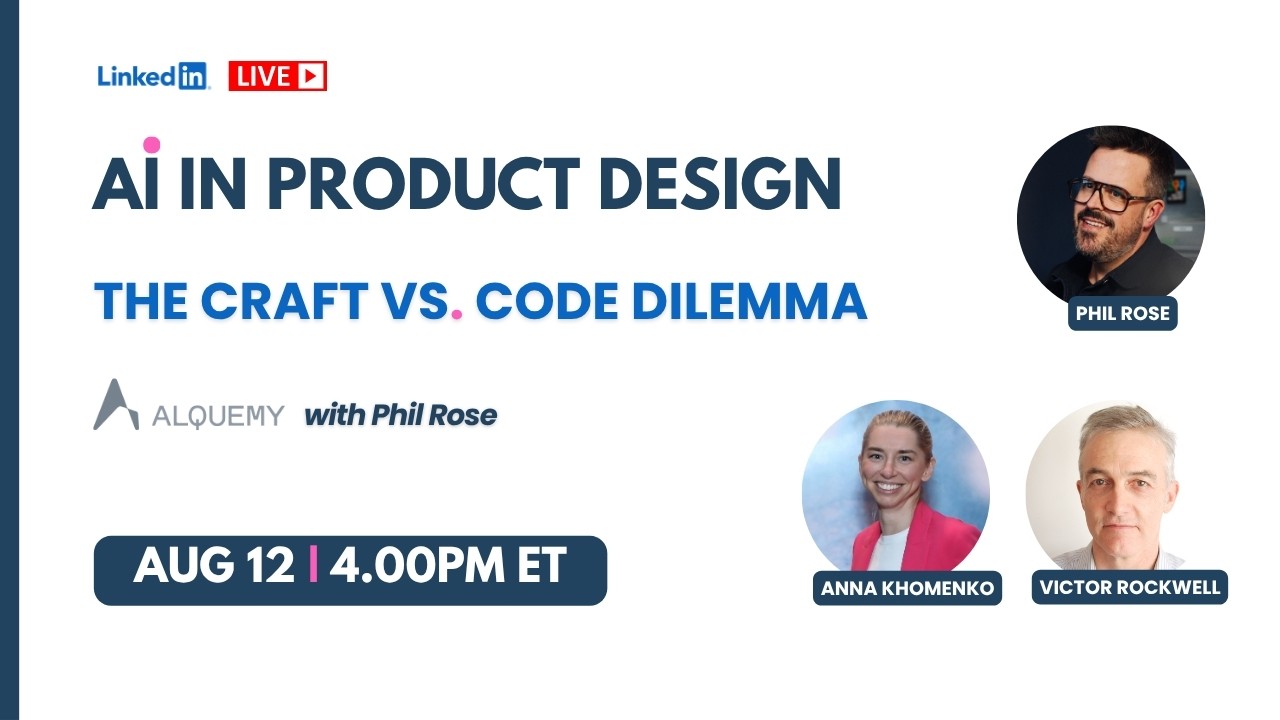
Consumer tech founders rushing to integrate AI into product design need to understand where automation helps and where it hurts. This episode reveals the hidden costs of AI-generated concepts that look impressive but fail regulatory approvals, cost more to manufacture, and confuse customers into returning products.

In this episode of Startup Dials Podcast series we explore the strategic use of AI in product design with Phil Rose, founder of Alchemy Design Agency and former designer at Breville and Williams Sonoma, who has shepherded millions of kitchen appliances from concept to retail shelf.


Key Takeaways:

  • Use AI as a research assistant for competitive analysis, patent landscapes, and user pain points - but always validate findings with real customer interviews

  • AI excels at generating mood boards and visual direction concepts in minutes rather than days, dramatically speeding client alignment phases

  • Almost all AI-generated product concepts have manufacturing red flags - missing draft angles, part lines, and technically impossible component packages that require significant redesign

  • The confidence of AI recommendations often masks fundamental flaws, similar to an overconfident university student who knows facts but lacks real-world experience

  • Preserve the human craft elements of design - the tactile experience, temperature, and physical interaction that customers actually feel and judge products by

Chapters:

[00:02:27] Introduction to Startup Dials and focus on consumer tech in kitchen space
[00:04:47] Phil's background and traditional four-phase design process (discover, define, develop, deliver)
[00:05:46] How AI helps in early research phases - competitive analysis and user research acceleration
[00:07:39] AI for patent landscape analysis - navigating 600+ intellectual property filings efficiently
[00:09:13] Generating mood boards with AI - from 3 days of Pinterest searching to instant visual direction
[00:11:24] The gap between AI concepts and real user testing - never showing AI work directly to customers
[00:13:58] Customer research methods - in-person interviews and ethnographic studies remain irreplaceable
[00:16:10] Post-launch iteration challenges for startups vs established brands with 5-year roadmaps
[00:19:31] Why founders skip customer research - prioritizing marketing budgets over understanding users
[00:21:47] Manufacturing red flags in AI concepts - technical packages that sound confident but are fundamentally flawed
[00:25:35] Phil's ideal clients - kitchen-focused startups seeking to humanize technology without over-engineering
[00:28:54] Actionable advice - using ChatGPT for founder-consultant alignment and concept development


By: Anna Khomenko

Consumer tech founders rushing to integrate AI into product design need to understand where automation helps and where it hurts. This episode reveals the hidden costs of AI-generated concepts that look impressive but fail regulatory approvals, cost more to manufacture, and confuse customers into returning products.

In this episode of Startup Dials Podcast series we explore the strategic use of AI in product design with Phil Rose, founder of Alchemy Design Agency and former designer at Breville and Williams Sonoma, who has shepherded millions of kitchen appliances from concept to retail shelf.


Key Takeaways:

  • Use AI as a research assistant for competitive analysis, patent landscapes, and user pain points - but always validate findings with real customer interviews

  • AI excels at generating mood boards and visual direction concepts in minutes rather than days, dramatically speeding client alignment phases

  • Almost all AI-generated product concepts have manufacturing red flags - missing draft angles, part lines, and technically impossible component packages that require significant redesign

  • The confidence of AI recommendations often masks fundamental flaws, similar to an overconfident university student who knows facts but lacks real-world experience

  • Preserve the human craft elements of design - the tactile experience, temperature, and physical interaction that customers actually feel and judge products by

Chapters:

[00:02:27] Introduction to Startup Dials and focus on consumer tech in kitchen space
[00:04:47] Phil's background and traditional four-phase design process (discover, define, develop, deliver)
[00:05:46] How AI helps in early research phases - competitive analysis and user research acceleration
[00:07:39] AI for patent landscape analysis - navigating 600+ intellectual property filings efficiently
[00:09:13] Generating mood boards with AI - from 3 days of Pinterest searching to instant visual direction
[00:11:24] The gap between AI concepts and real user testing - never showing AI work directly to customers
[00:13:58] Customer research methods - in-person interviews and ethnographic studies remain irreplaceable
[00:16:10] Post-launch iteration challenges for startups vs established brands with 5-year roadmaps
[00:19:31] Why founders skip customer research - prioritizing marketing budgets over understanding users
[00:21:47] Manufacturing red flags in AI concepts - technical packages that sound confident but are fundamentally flawed
[00:25:35] Phil's ideal clients - kitchen-focused startups seeking to humanize technology without over-engineering
[00:28:54] Actionable advice - using ChatGPT for founder-consultant alignment and concept development


By: Anna Khomenko

Consumer tech founders rushing to integrate AI into product design need to understand where automation helps and where it hurts. This episode reveals the hidden costs of AI-generated concepts that look impressive but fail regulatory approvals, cost more to manufacture, and confuse customers into returning products.

In this episode of Startup Dials Podcast series we explore the strategic use of AI in product design with Phil Rose, founder of Alchemy Design Agency and former designer at Breville and Williams Sonoma, who has shepherded millions of kitchen appliances from concept to retail shelf.


Key Takeaways:

  • Use AI as a research assistant for competitive analysis, patent landscapes, and user pain points - but always validate findings with real customer interviews

  • AI excels at generating mood boards and visual direction concepts in minutes rather than days, dramatically speeding client alignment phases

  • Almost all AI-generated product concepts have manufacturing red flags - missing draft angles, part lines, and technically impossible component packages that require significant redesign

  • The confidence of AI recommendations often masks fundamental flaws, similar to an overconfident university student who knows facts but lacks real-world experience

  • Preserve the human craft elements of design - the tactile experience, temperature, and physical interaction that customers actually feel and judge products by

Chapters:

[00:02:27] Introduction to Startup Dials and focus on consumer tech in kitchen space
[00:04:47] Phil's background and traditional four-phase design process (discover, define, develop, deliver)
[00:05:46] How AI helps in early research phases - competitive analysis and user research acceleration
[00:07:39] AI for patent landscape analysis - navigating 600+ intellectual property filings efficiently
[00:09:13] Generating mood boards with AI - from 3 days of Pinterest searching to instant visual direction
[00:11:24] The gap between AI concepts and real user testing - never showing AI work directly to customers
[00:13:58] Customer research methods - in-person interviews and ethnographic studies remain irreplaceable
[00:16:10] Post-launch iteration challenges for startups vs established brands with 5-year roadmaps
[00:19:31] Why founders skip customer research - prioritizing marketing budgets over understanding users
[00:21:47] Manufacturing red flags in AI concepts - technical packages that sound confident but are fundamentally flawed
[00:25:35] Phil's ideal clients - kitchen-focused startups seeking to humanize technology without over-engineering
[00:28:54] Actionable advice - using ChatGPT for founder-consultant alignment and concept development


Latest Blog

Stay up to Date with the Latest News

Welcome to Startup Dials

Your partner in achieving next-level growth.

For over 8 years, I’ve successfully launched 20+ smart home and kitchen products and brands, scaling from crowdfunding to retail across the US. My 17 years living in China helps me understand tech founders on a deeper level, while working closely with US consumers creates the perfect overlap, bringing the 2 worlds together.

I've watched too many brilliant hardware founders:

Hire a junior marketer and hope they grow into the role or

Pay $200K+ for a CMO when you're still figuring out product-market fit

The fractional model fixes this.

Welcome to Startup Dials

Your partner in achieving next-level growth.

For over 8 years, I’ve successfully launched 20+ smart home and kitchen products and brands, scaling from crowdfunding to retail across the US. My 17 years living in China helps me understand tech founders on a deeper level, while working closely with US consumers creates the perfect overlap, bringing the 2 worlds together.

I've watched too many brilliant hardware founders:

Hire a junior marketer and hope they grow into the role or

Pay $200K+ for a CMO when you're still figuring out product-market fit

The fractional model fixes this.

Welcome to Startup Dials

Your partner in achieving next-level growth.

For over 8 years, I’ve successfully launched 20+ smart home and kitchen products and brands, scaling from crowdfunding to retail across the US. My 17 years living in China helps me understand tech founders on a deeper level, while working closely with US consumers creates the perfect overlap, bringing the 2 worlds together.

I've watched too many brilliant hardware founders:

Hire a junior marketer and hope they grow into the role or

Pay $200K+ for a CMO when you're still figuring out product-market fit

The fractional model fixes this.